Clean Beauty Claims Explained: Organic, Natural, Vegan, Cruelty-Free
Table of Contents
Transparency builds trust. Trust grows customers.
The Clean beauty is a movement built on safer formulas and ingredient transparency, but it's far from a perfect system. Two brands can use the same claim to mean completely different things – and without certification, there's no way to tell them apart.
Independent bodies like ECOCERT, operating under the COSMOS standard, exist to fix that. They set the benchmarks. They do the auditing.
This guide explains how.
Let’s break down the four most common clean beauty claims: organic, natural, vegan, and cruelty-free. We’ll look at what each one actually means, how they're certified, where they overlap, and where they don't. In the end, you should know how to separate truth from branding.
Key Takeaways
Clean beauty has no legal definition. Any brand can use the term freely.
Organic, natural, vegan, and cruelty-free each cover a different dimension of a product.
A claim printed on packaging is not the same as a certified claim. One is marketing, the other is independently verified.
The most rigorous certifications – COSMOS, Leaping Bunny, The Vegan Society – require audits, not just brand declarations.
Greenwashing is common because most clean beauty terms carry no legal weight.
Brands that verify certifications across claims are the ones that hold up to retailer and consumer scrutiny.
What are Clean Beauty Claims?
Clean beauty doesn't have a legal definition – not in the US, not in the EU, not anywhere. No regulatory body owns the term, which means any brand can use it to mean whatever they want.
One brand's "clean" formula might exclude parabens and synthetic fragrance. Another's might simply mean "feels fresh." Same claim, completely different standards.
That's the core problem. Clean beauty functions as an umbrella concept. It’s a signal of intent rather than a verifiable, measurable commitment.
And with the global clean beauty market valued at around $10.5 billion in 2025 and projected to reach $35.3 billion by 2033, the stakes for getting this right are high. Consumer demand is real, and so is the incentive to claim clean without actually being it. Ultimately, trust is earned.
How Are Beauty Certifications Classified?
So, not all beauty claims are created equal. Some carry legal weight, but others are entirely self-declared, with no verification required and no consequences for getting it wrong.
A claim is not a certification.
This is the most important distinction in clean beauty labeling.
A brand can print "natural," "clean," or "cruelty-free" on a product with zero external validation. A certified claim means an independent body has reviewed the formulation, sourcing, or testing practices, and confirmed they meet a defined standard.
Government-Backed Frameworks
Government bodies set the floor for what brands can and can't claim. But in most markets, that floor is surprisingly low.
FDA (US): Oversees cosmetic safety but doesn't define or regulate terms like "natural" or "clean."
USDA (US): The exception. Its National Organic Program certifies agricultural ingredients as organic, and cosmetics can carry the USDA Organic seal only if they meet strict formulation thresholds.
EU Regulation 655/2013: Requires cosmetic claims to be truthful and substantiated, but stops short of defining what most clean beauty terms actually mean.
Third-Party Certification Bodies
This is where the real standards live.
Organizations like ECOCERT (under the COSMOS standard), Leaping Bunny, and The Vegan Society each maintain their own criteria, audit processes, and licensed logos.
These certifications are voluntary, so no brand is required to obtain them. But when their logo appears on packaging, it represents a verified commitment, not a marketing decision.
Main Beauty Industry Certification Bodies
Hundreds of logos float around the beauty industry, but only a handful represent genuinely rigorous standards. Here are the ones worth knowing.
| Certification Body | Claim Type | Region | What It Certifies |
| USDA National Organic Program (NOP) | Organic | US | 95-100% certified organic agricultural ingredients; no synthetic pesticides, GMOs, or prohibited substances |
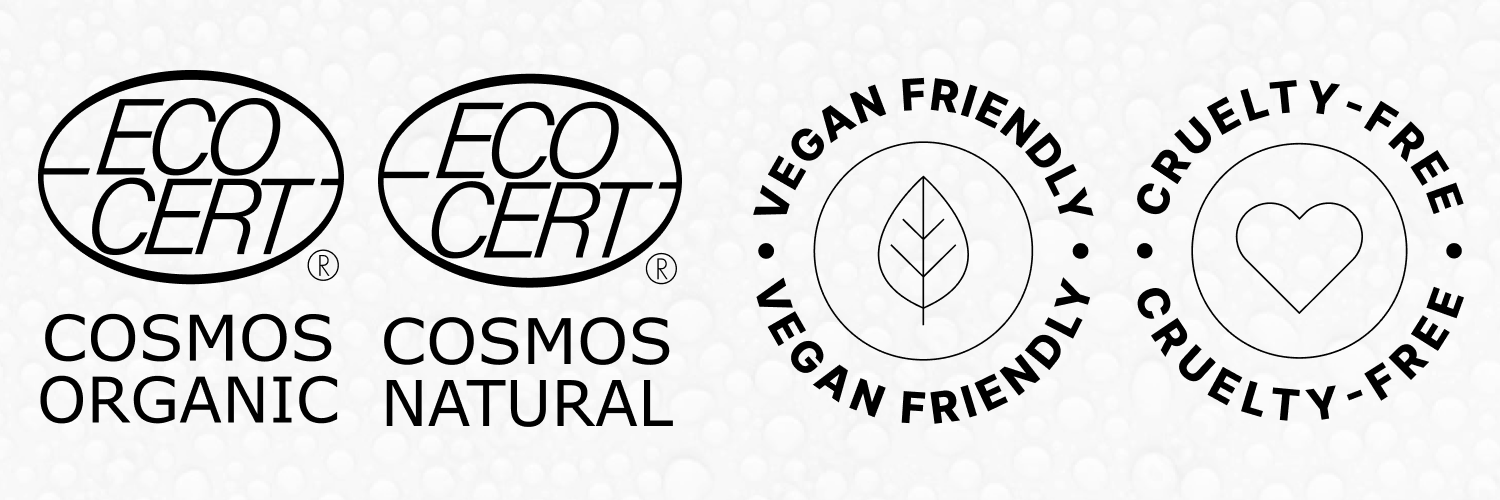
| COSMOS-standard (ECOCERT, BDIH, Soil Association, Cosmébio) | Organic / Natural | Global (EU-primary) | Organic and natural ingredient sourcing, manufacturing processes, and packaging sustainability |
| The Vegan Society | Vegan | Global | No animal-derived ingredients or by-products; no animal testing at any stage |
| Certified Vegan (Vegan Action) | Vegan | Global (US-primary) | No animal ingredients, by-products, or animal testing; no GMOs derived from animals |
| PETA Beauty Without Bunnies | Cruelty-Free / Vegan | Global | No animal testing by the brand or suppliers; separate vegan certification available |
| Leaping Bunny (Cruelty Free International) | Cruelty-Free | Global | No animal testing at any stage of production, including ingredient suppliers – the most stringent cruelty-free standard |
| EWG Verified | Clean / Safety | US | No ingredients of concern per EWG's database; full transparency and ingredient disclosure |
A product can hold more than one certification, and the strongest formulas usually do. A COSMOS-certified formula that's also Certified Vegan addresses organic integrity, ingredient sourcing, and animal testing – independently verified at every stage. You can see how Selfnamed stacks these on the concerns and claims page.
What Does "Organic" Mean in Beauty?
In the context of beauty and personal care, organic refers to how ingredients are grown and processed. An organically sourced ingredient comes from farming practices that avoid synthetic inputs and prioritize soil health. It’s the idea being that cleaner cultivation leads to cleaner ingredients. When a certification body verifies this, the claim carries real weight.

Who certifies it?
USDA National Organic Program: Certifies products with 95-100% organic agricultural ingredients, the primary organic standard for cosmetics in the US.
COSMOS Organic (via ECOCERT, etc.): Certifies organic ingredient sourcing, manufacturing processes, and packaging, the primary standard in the EU and internationally.
What certified organic requires
To earn the USDA Organic seal, a cosmetic product must contain 95-100% certified organic agricultural ingredients – meaning ingredients grown on soil free from prohibited substances for at least three years prior to harvest, with no synthetic pesticides, fertilizers, or GMOs permitted.
The COSMOS Organic standard applies similar principles but also evaluates manufacturing processes and packaging sustainability, making it arguably the more comprehensive framework for beauty products specifically.
What certified organic doesn't mean
Certified organic says something specific about how ingredients were grown. It says nothing about whether a formula is safe, effective, vegan, or cruelty-free. An organic product can still contain animal-derived ingredients. It can still cause skin reactions. And an uncertified product making organic claims is, without a seal, simply marketing copy.
What Does "Natural" Mean in Beauty?
In general use, "natural" refers to ingredients derived from plant, mineral, or animal sources rather than synthesized in a lab. The concept is intuitive and consumer-friendly, which is exactly why it's so widely used (and so frequently stretched). Without a certification standard to anchor it, "natural" can mean almost anything a brand wants it to mean.
Who certifies it?
COSMOS Natural (via ECOCERT and others): Certifies that a product meets minimum thresholds for naturally sourced ingredients, restricts certain synthetics, and complies with manufacturing and packaging requirements.
What the COSMOS Natural standard requires
COSMOS Natural is the most widely recognized voluntary framework for natural cosmetics. To achieve certification, a product must meet minimum thresholds for naturally sourced ingredients, restrict the use of certain synthetic ingredients, and comply with manufacturing and packaging requirements. The standard distinguishes between ingredients that are truly natural and those that are "naturally derived". It’s a distinction worth understanding.
Natural – ingredients exist as found in nature, with minimal processing (e.g. shea butter, rose hip oil).
Naturally derived – Originated from a natural source but has been chemically processed or modified (e.g. sodium lauryl sulfate from coconut oil)
Both can legally appear on a "natural" product label, certified or not.
Does natural mean safer?
Not automatically. Natural ingredients can cause allergies, irritation, and sensitization just as synthetic ones can. The safety of an ingredient depends on its chemistry and concentration, not its origin.
Many natural ingredients – essential oils, botanical extracts, plant acids – carry real irritation and sensitization risk at certain concentrations. The safety of an ingredient depends on its chemistry and concentration, not its origin – a distinction our guide to natural vs. synthetic ingredients in cosmetics covers in detail.
What Does "Vegan" Mean in Beauty?
A vegan beauty product contains no animal-derived ingredients or animal by-products at the formulation stage. It's a claim about what goes into the product, not about how it was tested, how ingredients were sourced, or what the brand's broader ethics look like.
Who certifies it?
The Vegan Society (Vegan Trademark): Certifies no animal-derived ingredients, no animal testing at any stage, and no animal-derived GMOs
Vegan Action (Certified Vegan): Certifies no animal ingredients, by-products, or animal testing; strong reach in the US market
What certification requires
The Vegan Society's Vegan Trademark – one of the oldest and most internationally recognized standards – requires that a product contains no animal-derived ingredients or by-products, that no animal testing is conducted at any stage of production, and that no GMOs involving animal genes or animal-derived substances are used. Vegan Action's Certified Vegan program applies similar criteria, with particular reach in the US market.
Common animal-derived ingredients to watch for:
Beeswax (Cera Alba)
Carmine (CI 75470)
Lanolin (Lanolin)
Collagen / Elastin (Hydrolyzed Collagen)
Keratin (Hydrolyzed Keratin)
Silk proteins (Hydrolyzed Silk)
Honey (Mel)
Vegan vs. cruelty-free
This is the most common point of confusion in clean beauty labeling, and it matters.
A product can be entirely plant-based and still tested on animals. A product can be cruelty-free and still contain lanolin. The claims address different things entirely, which is why the strongest products carry both.
If you're building a vegan brand, our guide to vegan private label cosmetics manufacturers covers what to look for in a manufacturing partner.
What Does "Cruelty-Free" Mean in Beauty?
A cruelty-free product has not been tested on animals at any stage of its development. Not the raw ingredients, not the finished formula, and not by any third-party supplier acting on the brand's behalf.
That last part is important: a brand can avoid testing its own products while still sourcing ingredients from suppliers who test on animals. Rigorous certification addresses the full supply chain, not just the final product.

Who certifies it?
Leaping Bunny (Cruelty Free International): Certifies no animal testing across the brand and full supplier chain. Requires annual recommitment and independent audits.
PETA Beauty Without Bunnies: Certifies no animal testing based on brand-submitted declarations. No independent supplier audits.
Leaping Bunny, administered by Cruelty Free International, is the more rigorous of the two. It requires brands to recommit annually and conducts independent supplier audits across the entire supply chain. PETA's program is more accessible but relies on brand-submitted declarations rather than independent verification.
What cruelty-free doesn't cover
Cruelty-free is an animal testing claim only. It makes no statement about:
how ethically ingredients were sourced;
environmental impact of production;
worker welfare in the supply chain;
whether the product contains animal-derived ingredients.
How Do These Claims Overlap – and Where They Don't
Each clean beauty claim addresses a different dimension of a product. None of them implies the others, and confusing them is exactly what greenwashing relies on.
Claim comparison
| Claim | What it covers | What it doesn't cover | Legally regulated? | Certifiable? |
| Organic | How ingredients are grown: no synthetic pesticides, no GMOs, 3-year soil requirement. | Testing practices, animal-derived ingredients, manufacturing processes (unless COSMOS) | Yes. USDA NOP (US), COSMOS Organic (EU) | Yes |
| Natural | Ingredient origin: plant, mineral, or animal-derived rather than synthetic. | Specific percentages, processing methods, testing practices | No | Yes. COSMOS Natural |
| Vegan | Formulation: no animal-derived ingredients or by-products | How ingredients were tested, how they were grown, brand ethics | No | Yes. Vegan Society, Vegan Action |
| Cruelty-free | Testing: no animal testing by brand or suppliers at any stage | Ingredient composition, sourcing ethics, environmental impact | Partially. EU ban since 2013; 11 US states | Yes. Leaping Bunny, PETA |
The claims can stack.
Organic covers how ingredients were grown.
Natural covers where they came from.
Vegan covers what went into the formula.
Cruelty-free covers how it was tested.
A product that carries verified certifications across all four has been independently assessed at every stage – from soil to finished product – and that combination is meaningfully stronger than any single claim in isolation.
This is the standard Selfnamed holds its formulas to: ECOCERT-certified for organic and natural integrity, predominantly vegan, and committed to cruelty-free practices across its product range.


Common Greenwashing Tactics to Watch Out For
Clean beauty is one of the most greenwashed categories in the industry. The absence of regulation around most claims makes it easy for brands to use the language of transparency without the substance behind it.
These are the tactics to know.
Claim Language Without Certification Backing
The most common tactic. A brand prints "clean," "natural," "non-toxic," or "conscious" on its packaging with no third-party verification whatsoever. There's no logo, no certifying body, no auditable standard – just a word chosen for its marketing value.
Without a recognized seal, these terms are brand decisions, not verified commitments.
"With Organic Ingredients" vs. Certified Organic
These two phrases are not interchangeable, but they're designed to look like they are. A product labeled "with organic ingredients" can legally contain as little as 1% organic content. The rest of the formula can be entirely conventional.
Certified organic products, by contrast, must meet strict ingredient thresholds set by USDA NOP or COSMOS Organic and carry a recognized seal. If the word "organic" appears prominently but no seal is visible, look closer.
Unrecognized Cruelty-free Logos
Not all cruelty-free logos are equal. Some brands create their own in-house "cruelty-free" or "not tested on animals" badges – symbols that look like certification marks but represent nothing more than a self-declaration.
The only logos backed by independent verification are Leaping Bunny and, to a lesser extent, PETA's Beauty Without Bunnies. If a cruelty-free logo isn't one of these, it carries no external accountability.
"Natural" Formulas Built on Synthetic Bases
A formula can feature a handful of botanical extracts – rosehip, chamomile, green tea – while being built on a synthetic base of silicones, PEGs, or petroleum-derived emulsifiers.
Without COSMOS Natural certification or equivalent, there's no minimum threshold for how much of a formula actually needs to be natural. The front of the pack highlights the plant ingredients and the INCI list – the standardized ingredient label – tells the full story.
What About Legal Accountability?
In the US, the FTC's Green Guides define what sustainability claims like "environmentally friendly," "natural," and "chemical free" need to look like to avoid being considered deceptive.
They're not hard law, but courts reference them. With greenwashing class actions on the rise, many are targeting beauty brands over potentially harmful ingredients or misleading "clean" labeling. The gap between what a brand claims and what it can prove is becoming a liability.
Some cases get court dismissed. Others end in reformulations and settlements. Either way, the direction is clear: vague claims are a growing legal risk, not just a credibility one.
B Corp certification is a different kind of answer.
Unlike product-level certifications, B Corp is assessed at the company level by B Lab. It covers supply chain ethics, packaging materials, environmental impact, and worker welfare. The full picture behind the brand, including the formula.
Selfnamed is a certified B Corporation. If you're launching a private label brand and want clean claims that hold up at every level, explore our product catalog.
What This Means for Private Label Brands
Understanding these claims matters whether you're buying or building. If you're launching a brand, the decisions you make at the formulation stage determine what you can credibly say on the label – and what you can't.
Today's beauty consumer does their research.
According to Euromonitor's 2025 Voice of the Consumer survey, about one in four global consumers now identifies as a clean beauty advocate. 26% are actively using beauty apps to scan ingredients and product labels before purchasing. The tools that once required a chemistry degree are now a tap away. If your clean beauty claims don't hold up, people notice.
Retailers have raised the bar too.
It's not just consumers. The beauty industry's biggest retailers have built their own clean standards – and meeting them is increasingly a requirement for shelf space, not a bonus.
Clean at Sephora requires products to be free from over 50 synthetic or harmful ingredients, including parabens, phthalates, sulfates, mineral oils, and synthetic fragrances. Their Planet Aware seal goes further, covering ingredient sourcing, formulation, packaging, and consumer transparency across 30+ criteria.
Conscious Beauty at Ulta assesses clean formulation, cruelty-free and vegan status, and sustainability commitments side by side.
Credo Beauty bans over 2,700 ingredients – the strictest clean standard in retail, and one that's quietly become a benchmark for the wider cosmetics industry
The message is consistent: deceptive claims and vague marketing language don't survive retailer scrutiny. Brands that want to grow need certifications that actually mean something.
For a closer look at what this means in practice, why now is the moment to launch a clean makeup line covers the formulation and market context.

Launching clean from day one.
The good news? If you're launching a private label skincare brand, you don't have to build your certification stack from scratch.
Most Selfnamed products are COSMOS Natural or COSMOS Organic certified by ECOCERT Greenlife. This means the organic and natural integrity of every formula has already been independently verified. The range is predominantly vegan and cruelty-free across the board, free from synthetic ingredients that appear on major retailer banned lists.
That means your brand launches with clean beauty claims that hold up – to a consumer scanning ingredients in the beauty aisle, to a retailer reviewing your certification docs, and to the growing scrutiny that's become the new normal for beauty brands in 2026.
To Conclude
Clean beauty means nothing without verification. Reasonable consumers are getting better at reading product ingredients, identifying, and telling the difference between a certified claim and a marketing decision. Many brands in the clean beauty market are still catching up to that reality.
Each claim in this guide covers something different: how ingredients were grown, where they came from, what went into the formula, how it was tested. Together, built on real science and independently verified, they add up to something sustainable: a brand story that holds up anywhere you tell it.
Frequently Asked Questions
-
If you're building a brand, you'll likely need both because they cover different parts of the supply chain. Vegan certification covers what goes into the formula. Cruelty-free covers how it was tested.
A product can be 100% vegan and still tested on animals. A product can be cruelty-free and still contain honey or silk proteins. The strongest clean beauty brands carry both certifications, because together, they cover what the other misses.
-
No. This is one of the most common points of confusion in the beauty industry.
Natural refers to ingredient origin: plant, mineral, or animal-derived rather than synthetic.
Organic refers to how those ingredients were grown: without synthetic pesticides, GMOs, or prohibited substances, verified by a certification body like USDA or ECOCERT.
A product can use natural ingredients that were grown conventionally, with no organic certification in sight. And an organic product can still contain natural ingredients that cause irritation or allergic reactions. The words sound similar. The meaning is not.
-
Yes. Organic certification covers how ingredients are farmed and processed, but it says nothing about whether those ingredients come from animals.
COSMOS Organic, for example, allows ingredients naturally produced by animals, such as honey, beeswax, and milk. A fully certified organic formula can contain several animal-derived ingredients and still carry the ECOCERT seal. If vegan formulation matters to you or your customers, look for both certifications.
-
Officially? Nothing. Clean beauty has no legal definition in the US, the European Union, or anywhere else.
The FDA does not regulate the term. There are no prohibited ingredients that automatically disqualify a product from calling itself clean, no required certifications, and no governing body enforcing the claim.
In practice, clean beauty generally signals a focus on safety, ingredient transparency, and the removal of synthetic or harmful ingredients like parabens, formaldehyde, and potential endocrine disruptors.
But the definition shifts from brand to brand. Some brands' clean beauty claims are rigorous and certification-backed. Others are pure marketing. The only way to tell the difference is to look past the label.
-
The most reliable certifications in the beauty industry are those backed by independent audits and publicly searchable databases.
For organic and natural claims, COSMOS (via ECOCERT and others) is the gold standard internationally.
For cruelty-free, Leaping Bunny requires full supply chain audits and annual recommitment – making it more rigorous than PETA's self-reported program.
For vegan, The Vegan Society Trademark and Certified Vegan (Vegan Action) are the most widely recognized.
When in doubt, search the brand directly in the certifying body's public database. If they're not listed, the logo on the packaging means nothing.
Must read